
Most firms do not lose a case to a better lawyer. They lose it to the firm that showed up first in a search result, an AI answer or a phone call that actually got picked up.
That is why the marketing stack matters more heading into 2027 than it did five years ago. Buyers now start with a chatbot as often as a search bar, and the firm that gets named in that answer usually gets the enquiry.
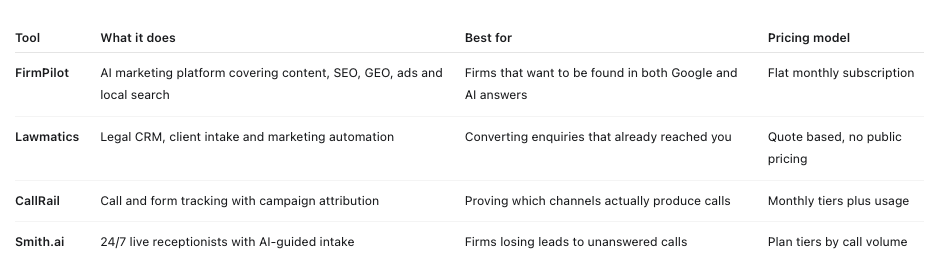
The four tools below cover the four jobs that decide whether marketing spend turns into signed clients: getting found, following up, measuring what worked and answering the phone.
Key Takeaways
- The 2027 stack has four jobs: visibility, follow-up, attribution and intake. Most firms overspend on the first and neglect the other three.
- AI answer engines are now a distinct visibility channel, and optimizing for them is not the same work as classic SEO.
- Attribution is the cheapest tool on this list and usually the one that changes budget decisions fastest.
- No platform here gives legal advice. Every one of them still needs a lawyer's judgment sitting on top of it.
- Pricing models differ sharply, from flat monthly subscriptions to usage-based billing that can run well above the advertised rate.
How we picked these four
Every tool here was checked against its own website rather than a roundup, and each covers a different stage of the client journey so the four work together instead of overlapping. We prioritized platforms built specifically for legal practices, since generic marketing software rarely accounts for practice areas, conflict checks or the ethics rules that govern attorney advertising.
Prices and plan names move. Treat the figures below as a starting point and confirm current rates before you budget.
1. FirmPilot
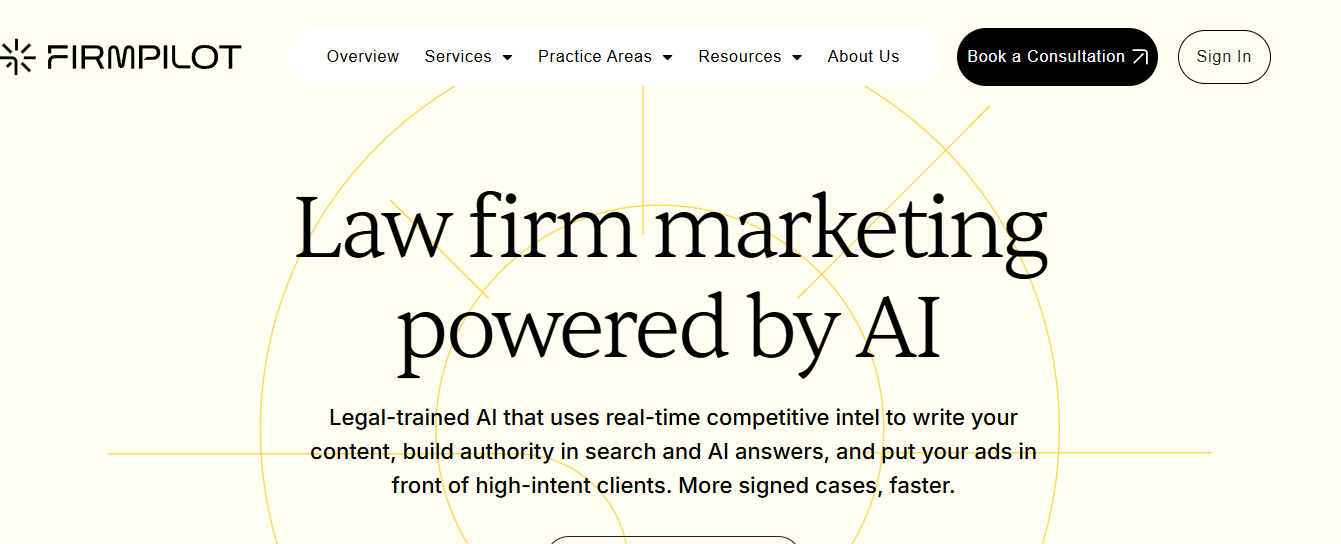
FirmPilot is an AI marketing platform built specifically for law firms, and it is the one on this list that treats AI answer visibility as a first-class channel rather than an afterthought. The company describes its technology as legal-trained AI that draws on a database of cases, legislation and legal news to produce content meant to rank in search and in AI answers.
The differentiator worth knowing about is the competitive monitoring. According to FirmPilot, the system crawls competitor activity every 90 minutes to map a firm's marketing landscape and surface untapped SEO, GEO and ad opportunities. That cadence is the argument for the platform, because most agencies audit competitors quarterly at best.
Coverage runs across content and SEO, on-page and website optimization, local SEO, PPC, digital PR and link building, and social. Campaign builds are organized by practice area, including personal injury, family law and divorce, criminal defense, employment, estate and probate, immigration, business law and bankruptcy, with separate tracks for solo, small and mid to large firms.
Pricing is a flat monthly subscription rather than a percentage of ad spend, which is unusual in legal marketing and makes budgeting more predictable. Published tiers are Lite at $4,250 per month, Firm at $6,900 and Premium at $9,250. The company is based in Miami and states plainly that it is not a law firm and does not provide legal advice.
Best for: firms with a real marketing budget that want search visibility, AI answer visibility and paid media handled in one place.
2. Lawmatics
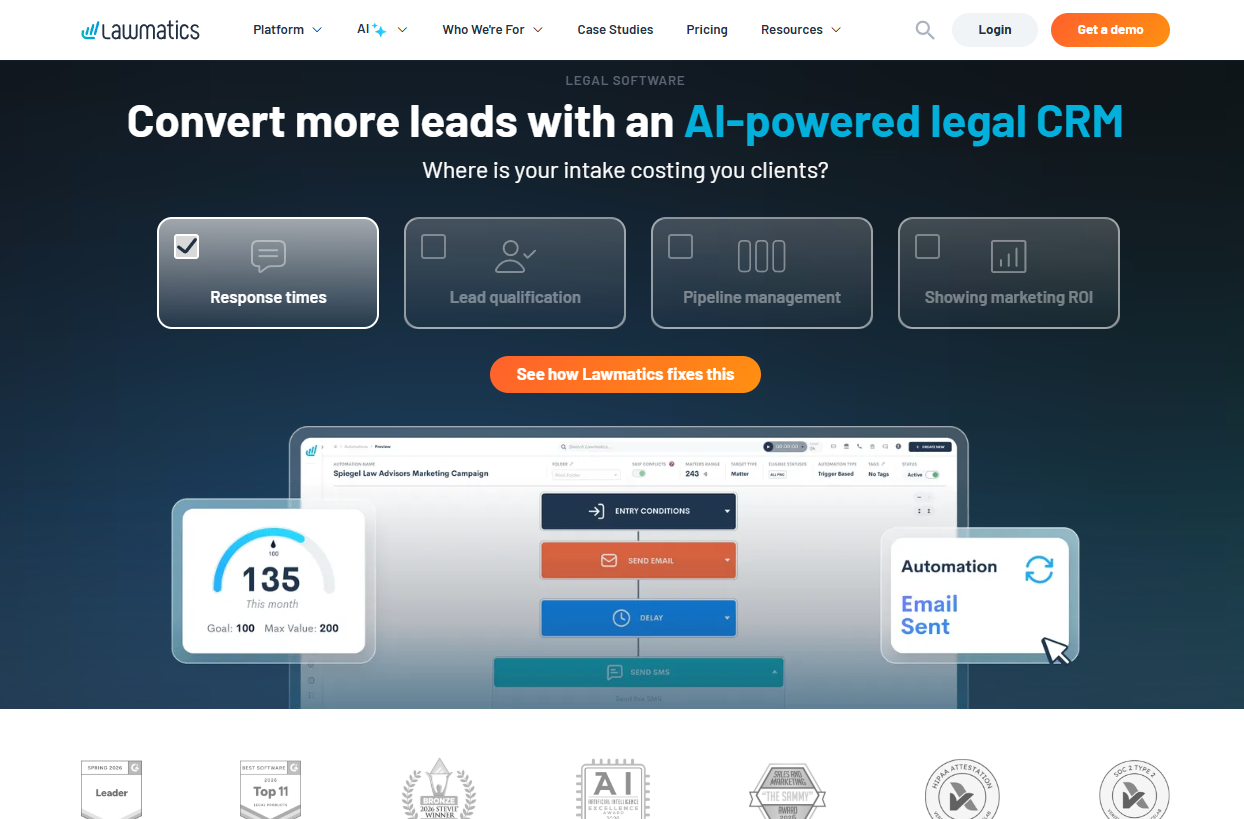
Getting found is only half the problem. Lawmatics exists for the other half, which is what happens in the days after someone fills in a form and hears nothing back.
The platform combines a legal CRM, client intake and marketing automation in one system, built in San Diego specifically for law firms. Firms can build drip email campaigns with drag and drop triggers and logic, then segment contacts dynamically by status, matter type, location and other criteria so follow-up messaging matches the situation.
Beyond email, it handles intake forms, appointment booking, document automation, e-signature, SMS and MMS, pipeline management, conflict checking and client portals. Reporting sits on top with custom dashboards and KPI tracking, so a managing partner can see conversion rates by source rather than guessing.
Lawmatics has also been layering AI into the intake path through its Merlin suite, starting with lead scoring to help firms prioritize the enquiries most likely to convert. It integrates with Clio, MyCase, Filevine, CARET Legal, and other core law firm software solutions, Google Ads, Gmail and Outlook, which matters if your practice management system is already fixed.
Pricing is not published. You book a demo and get a quote, so factor a sales conversation into your evaluation timeline.
Best for: firms with steady enquiry volume that are losing leads to slow or inconsistent follow-up.
3. CallRail
Ask most partners which marketing channel produced last month's best case and you will get a shrug or a guess. CallRail exists to end that conversation.
The platform assigns tracking numbers to individual campaigns, ads and keywords, then ties each inbound call back to the source that produced it. Its marketing analytics suite pairs call tracking with form tracking, so web enquiries and phone enquiries land in the same attribution picture instead of two disconnected reports.
Conversation Intelligence adds automatic transcription and trend analysis across calls, surfacing the questions and phrases prospects actually use. That is doubly useful, because the language in those transcripts is the language your content should be written in.
Treat the AI output with the same skepticism a careful practitioner brings to automating contract review. Automated summaries are a starting point for judgment, not a substitute for listening to the calls that matter.
One caution on budget. CallRail bills a monthly plan fee with usage charges layered on top for extra tracking numbers and minutes, and the plan lineup was restructured during 2026, so older comparison articles quote tiers that no longer exist. A free trial is available, with no credit card required.
Best for: any firm spending on ads or SEO without a reliable way to attribute the calls that result.

4. Smith.ai
The most expensive marketing failure in a law firm is not a bad ad. It is a qualified caller who reaches voicemail at 7pm and dials the next firm on the list.
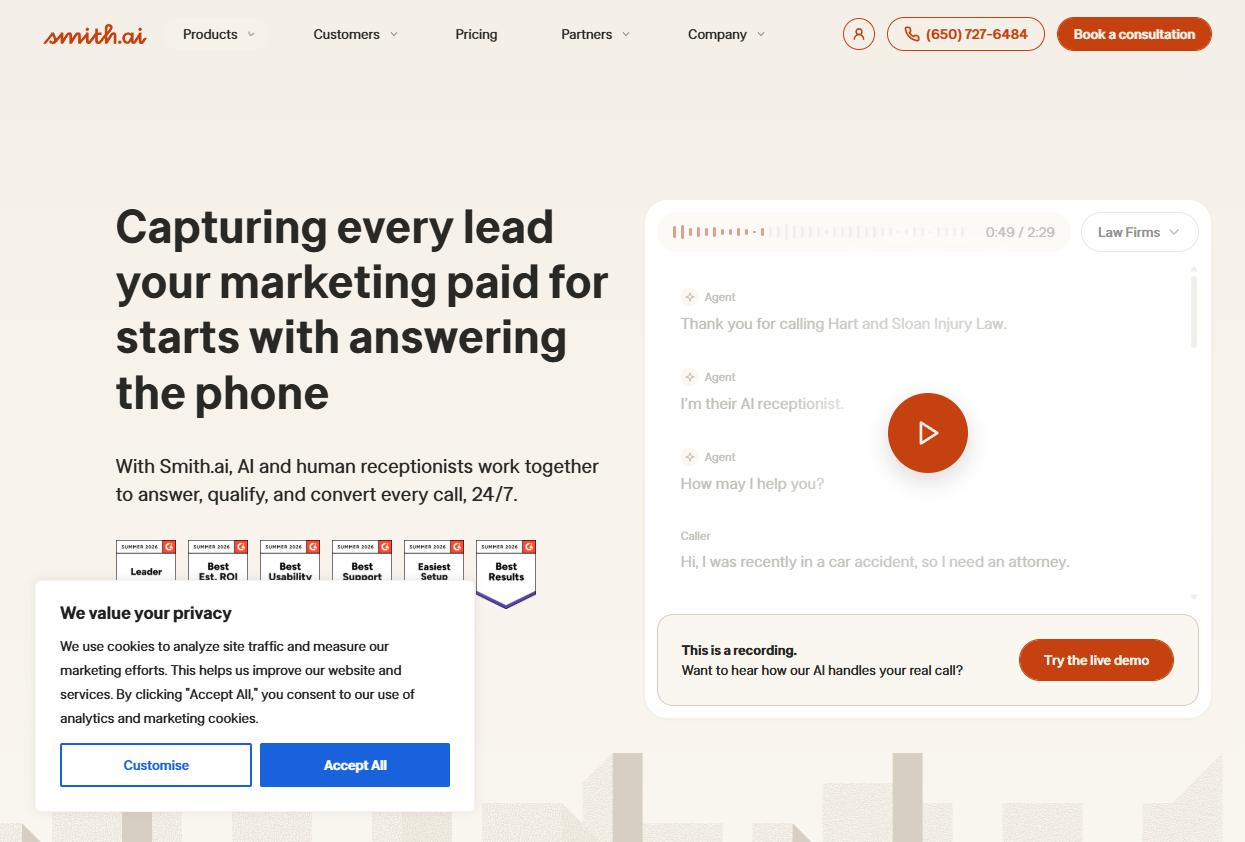
Smith.ai answers every call on its Virtual Receptionist plans with a real person, around the clock, guided in real time by proprietary AI the company says is trained on more than 25 million calls collected over a decade. Many of its receptionists are former paralegals or court staff, which shows in how they handle callers who are anxious, angry or in the middle of an emergency.
Receptionists never give legal advice or interpret a caller's matter. They collect information, qualify the lead against your intake criteria by practice area and matter type, then route or schedule according to your instructions, syncing the record into the practice management system you already use.
The service also covers outbound calls for appointment confirmations and follow-ups, plus web chat. Plans are tiered by call volume, so cost tracks with how busy your phones actually are.
Best for: solo and small firms without a dedicated intake coordinator, and any practice where calls arrive outside business hours.
Choosing between them
Start with the leak, not the tool. If enquiries are not arriving at all, visibility is the problem and an AI marketing platform is the right first spend. If enquiries arrive and go cold, buy the CRM before you buy more traffic.
If you genuinely do not know which of those two is happening, buy attribution first. Call and form tracking is the cheapest tool on this list, and it tells you where the money should go next.
One caveat that applies to all four. Attorney advertising rules vary by jurisdiction, and automated content and outbound messaging can create compliance exposure if nobody reviews them. Someone at the firm needs to own that review.
The bottom line
The firms that grow through 2027 will not be the ones with the biggest ad budget. They will be the ones who can name which channel produced each signed client, and who never let a qualified caller reach voicemail.
Pick the tool that fixes your weakest link, prove it works, then add the next one.
FAQ
What is the best law firm marketing tool for 2027?
For most firms, an AI marketing platform such as FirmPilot is the strongest single investment, because it covers search visibility, AI answer visibility and paid media in one subscription.
How much should a law firm spend on marketing software?
It varies widely by practice area and market. Full-service AI marketing platforms run several thousand dollars a month, while call tracking and CRM tools typically sit in the tens to low hundreds per user.
Do law firms need to optimize for AI answers as well as Google?
Yes. Prospects increasingly ask chatbots for recommendations, and being named in that answer is a separate discipline from ranking a page, which is why platforms now market GEO alongside SEO.
What is call tracking and why do law firms use it?
Call tracking assigns unique phone numbers to different campaigns so each inbound call can be traced back to the ad, keyword or page that produced it. Firms use it to stop funding channels that do not convert.
Can AI handle law firm client intake?
AI can qualify, route and score leads reliably, and it is increasingly used for after-hours coverage. Sensitive first conversations still tend to go better with a trained human, which is why hybrid models are common.
The opinions on this page are for general information purposes only and do not constitute legal advice on which you should rely.


