
Paying a supplier in Manchester is boring. Paying one in Manila, on time, in the currency they actually want, without three intermediary banks skimming the total, is a different exercise entirely.
Most finance teams discover this the hard way. The first international payment goes out through the business bank account, arrives four days late and short, and someone spends an afternoon working out where the missing money went.
The market has moved a long way since then. There are now dozens of providers competing for that flow, and they are not solving the same problem as each other. This guide covers what actually separates them and which five are worth putting on a shortlist.
Key takeaways
- Cross-border payment providers split into two broad camps: self-serve products a business uses directly and networks that platforms and financial institutions build on top of.
- Corridor coverage matters more than headline country counts, because reach into the specific markets you pay is what determines whether a payment lands.
- Total cost includes the FX margin, fixed transfer fees and the reconciliation time your team spends, not just the advertised rate.
- How recipients want to be paid varies enormously by market, and wallet coverage is often the deciding factor in emerging economies.
- Contract terms deserve the same scrutiny as pricing, particularly around FX transparency, service levels and exit rights.
Why this is harder than it looks
The traditional route sends money through correspondent banking. Your payment hops between intermediary institutions, each taking a cut and adding a delay, and nobody in the chain gives you visibility into where it currently sits.
Modern providers mostly avoid this by holding local balances or connecting directly to domestic clearing systems. When you pay a supplier in Brazil, the money often never crosses a border at all. A local payment goes out from funds the provider already holds there.
That architectural difference is why the newer platforms are faster and cheaper. It also explains why coverage varies so much, since building local presence in each market is slow, expensive and heavily regulated.
Product or network: the first question to answer
A product is something your finance team logs into. You open an account, upload a payment file and the provider handles the rest. This suits businesses paying suppliers, contractors or overseas staff directly.
A network is infrastructure. Banks, marketplaces, payroll platforms and payment service providers integrate it via API and use it to power payments inside their own product. The buyer here is usually an engineering or product function rather than finance.
Getting this wrong wastes months. A platform that needs programmable payouts for thousands of end users will outgrow a self-serve account quickly, and a twelve-person agency paying eight contractors does not need to integrate an API.
Five B2B cross-border payment solutions worth evaluating
These are ordered by breadth of reach rather than by fit, because fit depends entirely on your own flows. Match each description against how you actually pay rather than reading down the list in order.
1. Thunes
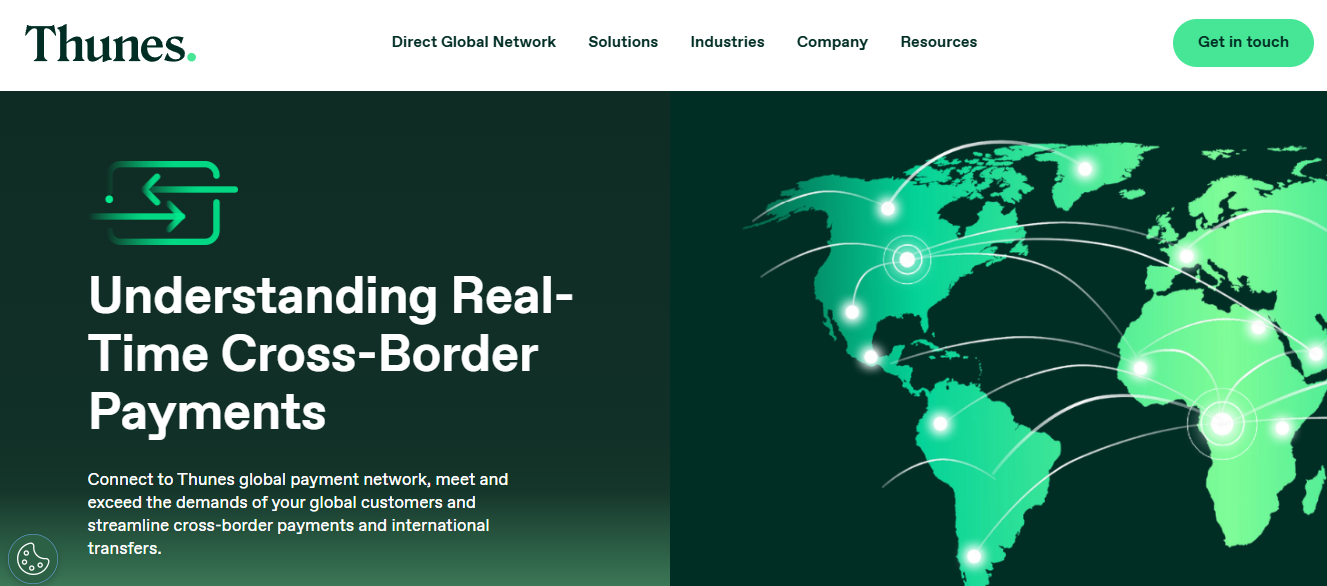
Thunes is a network rather than a product. Its Direct Global Network supports real-time payments across more than 140 countries and over 90 currencies, and businesses reach all of it through a single API integration rather than negotiating local partnerships market by market.
Reach is the point. The network connects to more than 12 billion mobile wallets, stablecoin wallets and bank accounts, plus 15 billion cards, through over 220 payment methods including GCash, M-Pesa, Airtel, MTN, Orange, JazzCash, Alipay and WeChat Pay. In markets where wallets rather than bank accounts are the norm, that coverage decides whether a payment can be delivered at all.
More than 720 Members sit on the network, spanning banks, mobile wallets, marketplaces and payment service providers. The company reports network uptime of 99.99%, which is the kind of figure that matters when your own product depends on someone else's rails.
For businesses looking specifically at payables, Thunes Business Payments launched in April 2025 with access to local ACH in over 50 countries, more than 30 currencies and USD wire transfers to over 170 countries. Taken together, these cross border payment solutions are aimed at organisations that want one integration to replace a patchwork of regional relationships, particularly where emerging market coverage is the constraint.
Best suited to: platforms, marketplaces, banks and payment providers that need broad reach, especially into wallet-heavy emerging markets.
2. Wise Business
Wise Business is the common starting point for small and mid-sized companies with straightforward international flows. It holds, sends and receives more than 40 currencies. Conversions run at the mid-market rate with the fee shown separately rather than buried in the spread.
The practical draw is local account details. A UK company can receive USD from an American client through what looks to that client like a normal domestic transfer, which removes wire fees from the customer side of the relationship.
Batch payments handle bulk runs, and accounting integrations such as Xero reduce the reconciliation load. It is not a bank, so there is no overdraft or credit facility, and pricing structures differ by region.
Best suited to: SMEs paying suppliers and contractors across major economies who want transparency without an integration project.
3. Payoneer
Payoneer grew up serving the marketplace and freelance economy, and that heritage still shapes the product. It is embedded across major seller platforms and freelance marketplaces, which makes it the path of least resistance for businesses whose income arrives from those channels.
It issues local receiving account details in major currencies, and transfers between Payoneer accounts move without charge. The flip side is a fee structure with more moving parts than the newer platforms, including conversion markups and account fees tied to activity levels.
One thing to factor into any procurement decision: on 15 June 2026, Payoneer announced a definitive agreement for Nuvei to acquire the business for approximately 2.75 billion dollars. The companies expect the deal to close in mid-2027, subject to shareholder and regulatory approvals. A pending change of ownership is worth raising in contract negotiations, particularly around continuity of service and exit rights.
Best suited to: businesses whose revenue flows through marketplaces and freelance platforms.
4. Airwallex
Airwallex bundles multi-currency accounts, FX, collections, payouts and corporate cards into one platform with a well-documented API. That combination appeals to companies that want a finance hub rather than a transfer tool.
It also operates a payment gateway with native support for Shopify, WooCommerce, BigCommerce and Magento, which matters if you are collecting from customers as well as paying suppliers. The company promotes zero-fee domestic transfers within its network.
Its coverage is strongest across Asia-Pacific, reflecting where it built out first. For a business whose flows concentrate in that region, this is a meaningful advantage over providers with a Western centre of gravity.
Best suited to: digital-first companies that collect and pay across multiple currencies and want developer access alongside a finance dashboard.
5. Nium
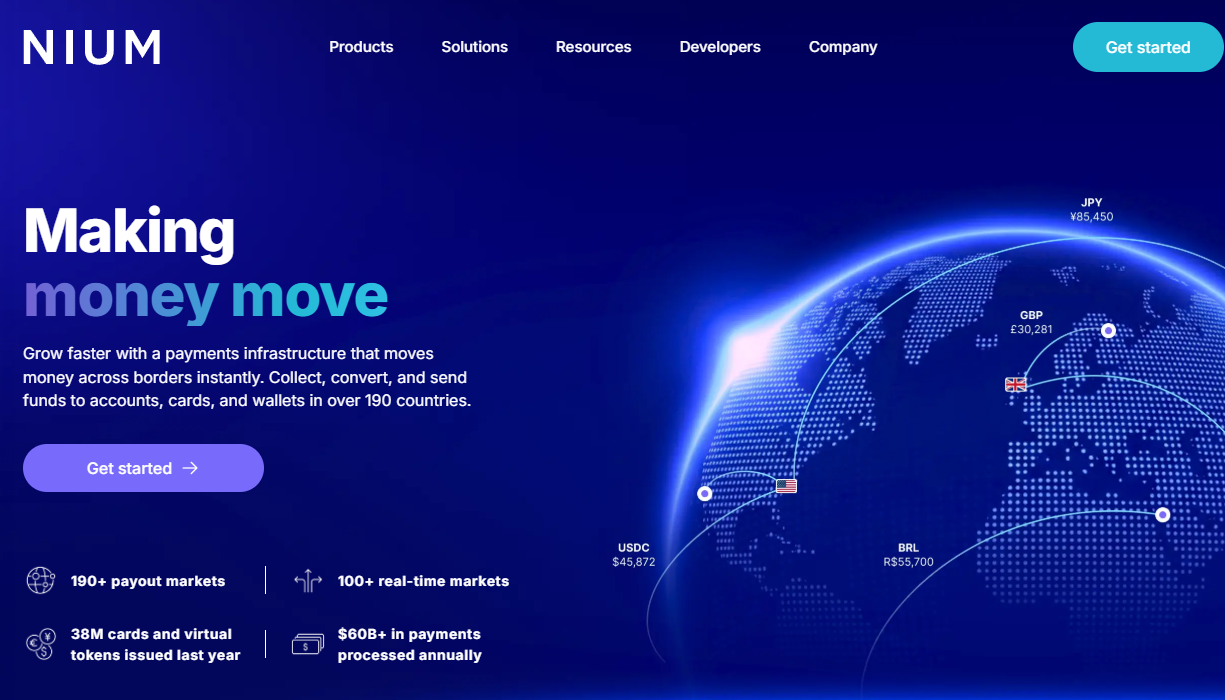
Nium, formerly InstaReM and co-headquartered in San Francisco and Singapore, sells infrastructure rather than a finance-team product, with card issuance as its distinguishing feature. Its payout network reaches more than 190 countries with real-time delivery available in over 100 of them, supporting 100-plus currencies.
Payments route across Swift, ACH, SEPA, wires and domestic real-time systems, delivering to bank accounts, cards and wallets. The platform also covers card issuing, bank account verification in over 50 countries and local collection in 40 markets.
It holds regulatory licences and authorisations in over 40 countries, and the API is built around modular components so teams can adopt payouts, accounts or cards independently.
Best suited to: fintechs, payroll providers and platforms building embedded payment features who want real-time coverage and card issuance in one stack.
The contract questions that matter
Pricing pages tell you very little about what you are actually agreeing to. Before signing, work through the same discipline you would apply to any supplier, and a vendor contract risk checklist is a reasonable place to start.
Pin down how FX is priced and whether the margin is disclosed separately from the rate. A provider quoting a low transfer fee while embedding two percent in the exchange rate is more expensive than one charging a visible fee on the mid-market rate.
Check the service levels attached to settlement times and what happens when a payment fails or is returned. Ask who bears the loss on a misrouted transaction and how long funds can sit unreconciled before someone owes you an explanation.
Exit rights deserve attention too. Payment providers hold your money and your payee data, so the agreement should say clearly how quickly you can withdraw balances and extract records if you leave.
Picking the provider is the easy part. The harder question, and the one that tends to surface six months in, is who actually runs the work around the platform: chasing a supplier for banking details, resolving a payment that bounced, matching a remittance that arrived without a reference.
This is where Corpay sits on the domestic AP side. We are a payments company with a managed service, not a portal you log into alone. Corpay handles the full digital AP workflow, purchase orders through invoice processing, approvals, payment execution by virtual card, ACH or check, vendor questions and reconciliation back into the ERP. Vendors enroll themselves and update their own details through a portal, which takes the back-and-forth off the AP team.
The mechanism matters because it changes what finance owns. Corpay reports that automated routing and approvals save AP teams about 40% of processing time, and the virtual card leg (single-use numbers rather than a static account) reduces fraud exposure while generating rebate on spend that would otherwise go out as a check. Corpay reports paying out more than $800M in rebates annually across its base.
One practical note for anyone running an ERP evaluation at the same time: Corpay maintains 100+ ERP and accounting integrations, including NetSuite, Sage Intacct, Microsoft Dynamics 365 Business Central and Acumatica, with most teams live in weeks rather than months. Ask any shortlisted AP provider the same contract questions a cross-border provider gets: who owns the exceptions, who absorbs the loss on a misrouted payment, and how fast your data comes back if you leave.
How to actually run the shortlist
Start with your real payment data rather than a feature comparison. Pull last quarter's international payments, group them by destination country, currency and value band, and you will usually find that a handful of corridors account for most of the volume.
Then test those corridors specifically. A provider with impressive global coverage can still be slow or expensive on the one route that carries half your spend, and no marketing page will tell you that.
Ask each shortlisted provider to quote against your actual mix, including the FX margin expressed in basis points. Vague answers at this stage tend to predict vague invoices later.
Final thoughts
There is no single answer here, and any guide that names one is ignoring how different these businesses are from each other. A SaaS company paying 200 contractors has almost nothing in common with a marketplace collecting from buyers across Latin America.
What does generalise is the method. Work out whether you need a product or a network, map your genuine corridors, test the routes that carry your volume and read the contract as carefully as the pricing page. Do that and the shortlist tends to narrow itself.
Frequently asked questions
What is the difference between a payment product and a payments network?
A product is a self-serve tool your finance team uses directly, with an account, a dashboard and an upload screen. A network is infrastructure that platforms, banks and payment service providers integrate via API to power payments inside their own services. Some providers offer both, but the buying process and the internal owner are usually different.
How long should an international B2B payment take?
It depends entirely on the corridor and the rails involved. Payments routed over domestic real-time systems can settle in seconds, while transfers relying on correspondent banking can take several working days. Ask providers for settlement times on your specific routes rather than accepting a general figure.
What hidden costs should businesses watch for?
The FX margin is the most common one, since a provider can advertise a low transfer fee while pricing the exchange rate two percent away from mid-market. Also check for fixed receiving charges on inbound wires, account maintenance fees tied to activity levels and the internal cost of reconciling payments manually when a provider gives poor remittance data.
Do we still need a business bank account?
In most cases yes. These platforms are generally licensed as payment institutions or money transmitters rather than banks, which means they typically do not offer credit facilities, overdrafts or the same deposit protection. Most businesses run a payment provider alongside a bank rather than as a replacement for one.
The opinions on this page are for general information purposes only and do not constitute legal advice on which you should rely.


